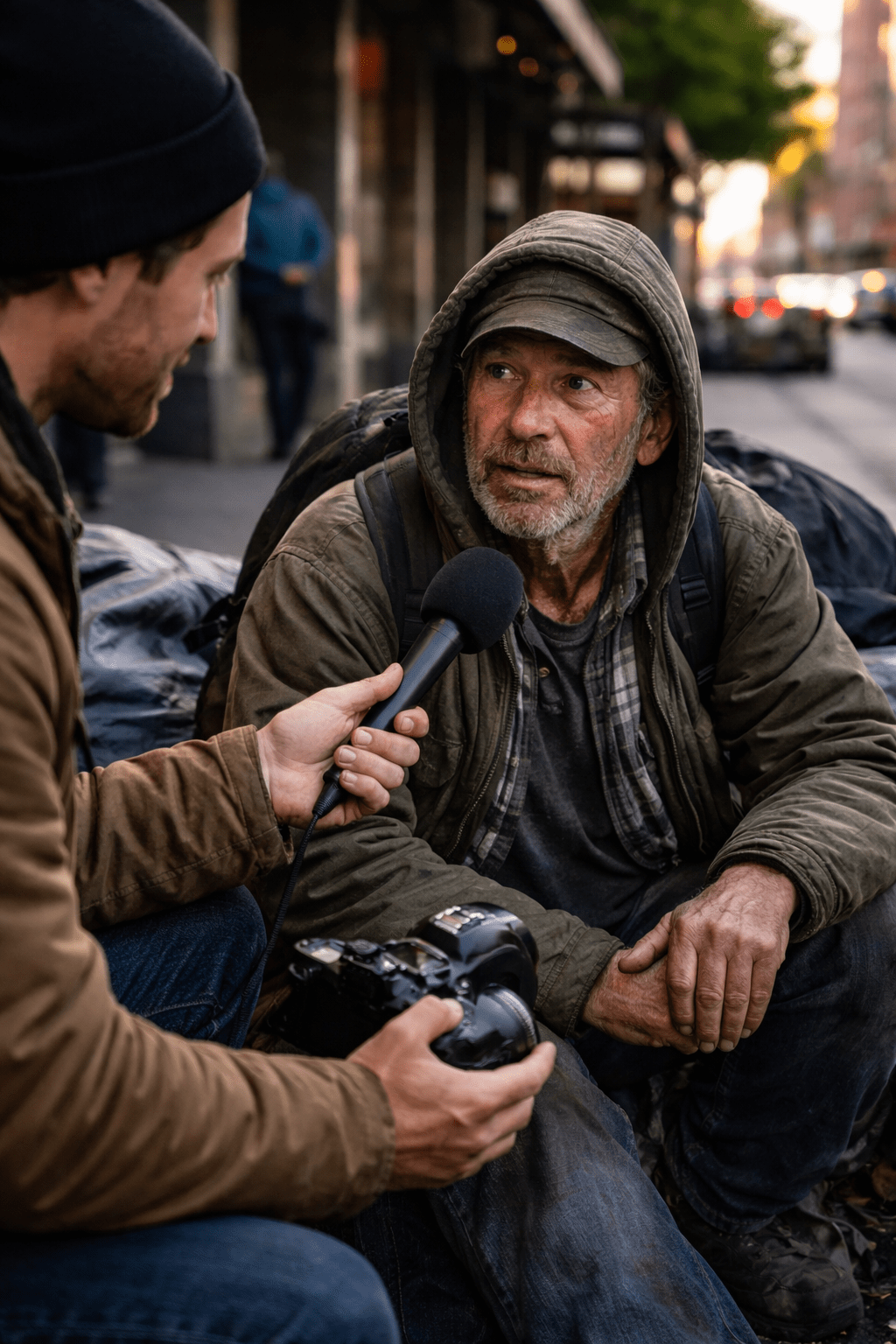
What I Learned Interviewing Homeless Individuals About Culture, Community, and Human Survival
————————————————————————
Excerpt:
In my first interview project, I spoke with people experiencing homelessness through both recorded and off-camera conversations. What I found was not just hardship, but complex communities, survival-based cultures, deep psychological insight, and a level of humanity too often ignored from a distance.
————————————————————————
Recently, I completed a first project involving both recorded and off-camera interviews with people experiencing homelessness. This project was part of a larger mission of mine: to better understand humanity by listening directly to people and communities that society often overlooks, misunderstands, or keeps at a distance.
What I learned was powerful.
Too often, homelessness is discussed only from the outside. People are categorized, judged, studied, or reduced to a social issue without ever being truly heard. But when you sit down, ask real questions, and listen without arrogance, a much more complex picture begins to appear.
What many people call “homelessness” is often, in reality, a survival-based culture shaped by trauma, instability, rejection, scarcity, and adaptation. Within that world, there are often unspoken rules, social hierarchies, alliances, protective behaviors, territorial boundaries, and highly developed instincts about trust, danger, and survival. These patterns are not random. They are human responses to prolonged hardship.
Psychologically, I was struck by how much complexity could exist within a single conversation. I encountered grief, pride, intelligence, humor, shame, resilience, emotional insight, vigilance, and pain—often all in the same person. Many people are not simply without housing. They are carrying the weight of trauma, fractured family systems, untreated mental health struggles, addiction, abandonment, poverty, and the daily loss of dignity that comes from being unseen or misjudged.
And yet, even in that instability, community still exists.
People form bonds. They share information. They protect each other when they can. They create social structure, identity, meaning, and connection in places most of the world has stopped looking. That does not erase the danger, dysfunction, or suffering that can also be present, but it does remind us of something essential: human beings continue to create culture and community even under severe pressure.
That matters to me deeply.
My broader goal is not simply to observe people from a safe distance, but to document the lived realities, cultures, inner worlds, and psychologies of communities that are often ignored, misrepresented, or slowly disappearing from public understanding. I believe these stories matter. I believe they reveal truths about human nature that cannot be understood through statistics alone. And I believe that if we want to understand humanity honestly, we have to be willing to listen to the people the world most often walks past.
This first project is only a beginning, but it is a meaningful one.
My hope is to continue having real conversations, documenting them with respect, and building something that helps preserve human stories while offering a fuller, more honest understanding of survival, resilience, identity, suffering, and connection. I want this work to challenge assumptions, deepen empathy, and make people think more carefully about the worlds that exist all around them but are rarely seen clearly.
To everyone who shared their time and honesty with me during this project: thank you. Your voice matters.
And to those watching, reading, and following along, I would genuinely love to hear from you.
How did this first project make you feel? What stood out to you most? Did any part of it connect with your own experiences, beliefs, or view of people and society? I would truly value your honest thoughts in the comments.
If this mission resonates with you, your support, feedback, encouragement, and shared perspective truly mean a great deal as this work continues to grow.
 Vanishing cultures project
Leave a comment